From Großbodungen to the United States into Canada
Gustav A. Roedde (1860–1930) trained in Leipzig to become a bookbinder, emigrated to the United States and later to Canada. In Vancouver, on the Pacific coast of North America, he opened the city’s first bookbinding business. He would go on to become a vocal member of Vancouver’s German community.
by Vivian Davidson, Erin Dawson, and James Gibson
Gustav A. Roedde was born in 1860 in Großbodungen, a village in what is now Thuringia, Germany. In his later life, he would move to the United States, and then to Canada, where he became the city of Vancouver’s first bookbinder and a prominent member of the local German community.
In the 1860s, Großbodungen belonged to the administrative district of Erfurt, which was part of Prussia. It was a predominantly rural German village with life centered around agriculture, traditional social hierarchies, and the local church. The decade was also a period of significant political and economic transition as Prussia moved to unify the German states.
Amidst these changes, Roedde’s parents died, and a 14-year-old Gustav was left with no family. To support himself he apprenticed for seven years and learned his bookbinding craft in Leipzig. Großbodungen is approximately 164 km from Leipzig, and for Roedde to travel between the two meant he heavily relied on the expanding German railway network (Deutsche Reichsbahn).
From Leipzig to North America
By the time Roedde departed Germany for the United States in 1881, Leipzig had become the centre of the German book trade: with nearly fifty printing houses, over two hundred bookstores, bookbinding, type-founding, and other kindred trades. Leipzig was not only well known for bookbinding, but was also considered one of the great musical centres of Europe. The Leipzig orchestra, consisting of about twenty-five violins and some twenty-five other instruments, is said to have been the best in the world.
Roedde initially immigrated to Cleveland, Ohio, in 1881 to join an uncle who was already established there. When he arrived in Cleveland, however, he found that his uncle had died of yellow fever two months earlier. Unable to return, he stayed in Cleveland for a year or two, living with his aunt and working as a bookbinder. In 1883, he married Matilda Cassebohm, a woman from British controlled Heligioland who had immigrated to Cleveland a few years earlier.
The couple left for California, where Gustav taught various bookbinding techniques, and moved up the coast into
Canada reaching Victoria in the province of British Columbia (BC). The family eventually settled in Vancouver, BC, and in 1888 Gustav opened the city’s first bookbindery, “G.A. Roedde, Bookbinders, Stationers and Printers”, which would flourish alongside the city’s development in the following decades.
Toasting the Kaiser’s good health and singing German songs
Mr. Roedde’s dedicated involvement in the German community in Vancouver is easiest to find in historic newspaper clippings. In 1890, a celebration under the name Deutscher Liederkranz (German song wreath) was held. It featured a number of musical performances, and beautiful decorations that included “bunting, wreaths and festoons of artificial work [which] gave the ball room an appearance of beauty and comfort it seldom possessed.”
The Liederkranz ball was a great success, and Roedde was named as part of a committee that organized another event under the same name in 1893, which took place again at the Imperial Opera. At the event, alongside other prominent members of Vancouver’s German community, Roedde performed the sextet Der Gechers Wunsch “in good style.” This event also featured high-profile guests, such as the former mayor, and many other key members of Vancouver society who were not themselves members of the German-
Canadian community.
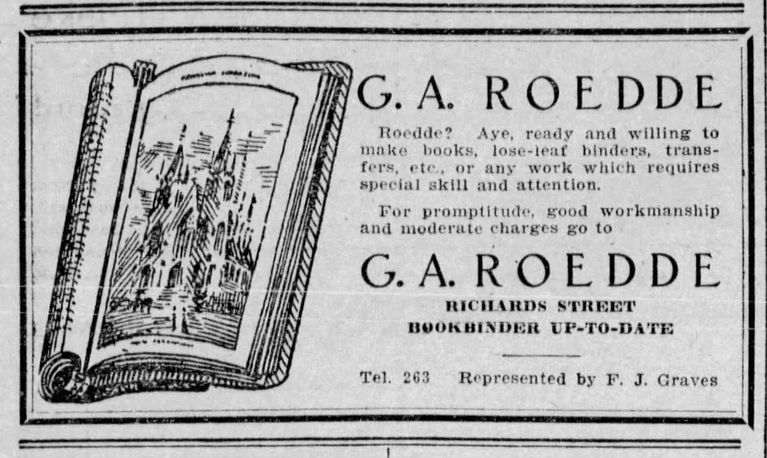
Advertisement for Roedde’s business in Vancouver, ca. 1906.
(© 2026 Newspapers.com)
On January 27, 1913, G.A. Roedde was mentioned as one of the “old-timers” in attendance for a celebration the German community held to honor the anniversary of Kaiser Wilhelm‘s birth. More than sixty guests attended, singing the German national anthem and toasting the Kaiser’s good health.
Unfortunately, anti-German sentiment increased in Canada during World War I. This is particularly notable in a local newspaper, which features several articles that display the rapid escalation of this broad distrust and paranoia. Many German-Canadians living in Vancouver were said to have left for the United States, including those with deep ties to the local community. One of these articles in particular contained inflammatory questions and far-fetched scenarios, claiming that “... nobody but Germans [w]ould get work. Canadians would be lucky to eat occasionally,” and “... if the carpenters went on strike they would go to prison or be shot.”
For Gustav Roedde, the threats and propaganda escalated to the point where he felt it necessary to defend his own position in public. At the BC Manufacturers Association in late May 1915, discussions were held regarding the internment of not only natives of Germany, Austria, and Turkey, but naturalized Canadian citizens as well. Roedde expressed that it was, of course, no fault of his own that he had been born in the German Empire: further, he had raised six children who were all Canadian citizens. It would not be right, he said, to intern people such as him and his family.
“[Roedde] said it was not any fault of his that he had been born in the German empire [...] and other Germans like him, would be found willing to fight for Canada.”
(The Vancouver Sun, May 28, 1915)
Fighting for the new homeland Canada
Gustav Roedde was an active member of the German community within Vancouver, yet clearly identified with his status as a Canadian citizen, arguing that he had every right to be considered both. All four of their sons, including adopted son Walter, served in the first World War, fighting on behalf of Canada despite the mixed feelings that came with Gustav’s dual German-Canadian identity. He was afraid, understandably so, that his sons may be forced to fight a relative. Fortunately, all of the boys returned home safe, and all but William repaired the strain this had caused to their relationship with their father.
Their eldest daughter, Emma Matilda, was born while the family was living in San Francisco in 1886. She wanted to be a milliner (a hat maker), and lived with her parents during the first world war. One of her daughters, Kay, later became British Columbia’s first female life guard.
Another daughter, Anna Catherine, trained as a student nurse at Vancouver General Hospital, but was killed in 1925 by one of her patients. The family was prominent enough in Vancouver society at the time that her death made front-page news and the family received an outpouring of public support, including many flags being flown at half-mast in recognition of the event.
Roedde and Vancouver today
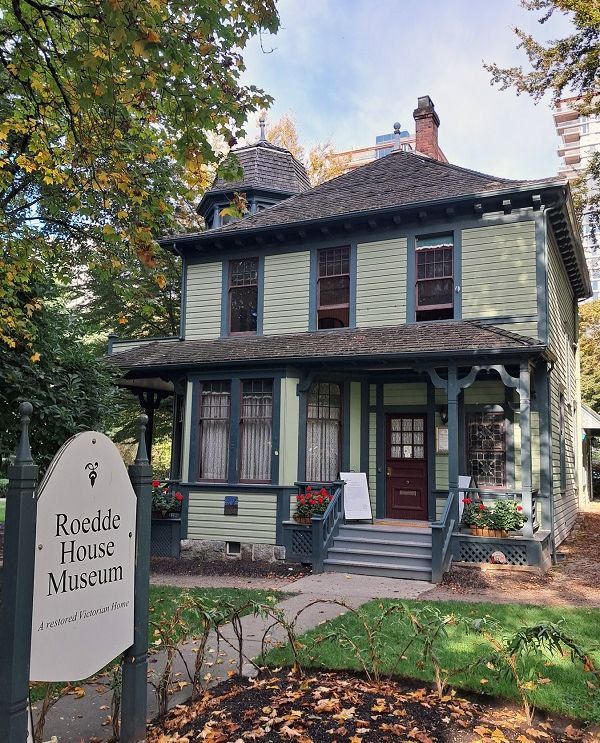
Today, Gustav Roedde’s story (and that of his family) is preserved by the Roedde House Museum. The house was constructed in 1893 in the Queen Anne Revival architectural style, and the Roedde family lived there until around 1924, when they moved to a residence elsewhere in the city. The house has been restored to resemble how it looked when the Roedde family resided there, through analysis of contemporary research and interviews with surviving Roedde descendents.
Exhibits in the house highlight different parts of the Roeddes’ life and work. Most of the family (including Matilda and many of the children) helped Gustav in his bookbinding business. In a city that had become Roedde’s new home, far away from his beginnings in the region today called Mitteldeutschland.
About the Authors
Written by staff of The Roedde House Museum in Vancouver, British Columbia, Canada. Situated on the unceded and ancestral lands of the xʷməθkʷəy̓əm
(Musqueam), Sḵwx̱wú7mesh (Squamish), and səlilwətaɬ (Tsleil-Waututh) Nations. Vivian Davidson and Erin Dawson are both dedicated volunteers at the Roedde House, and James Gibson is Acting Chairman of the Roedde House Museum Board.